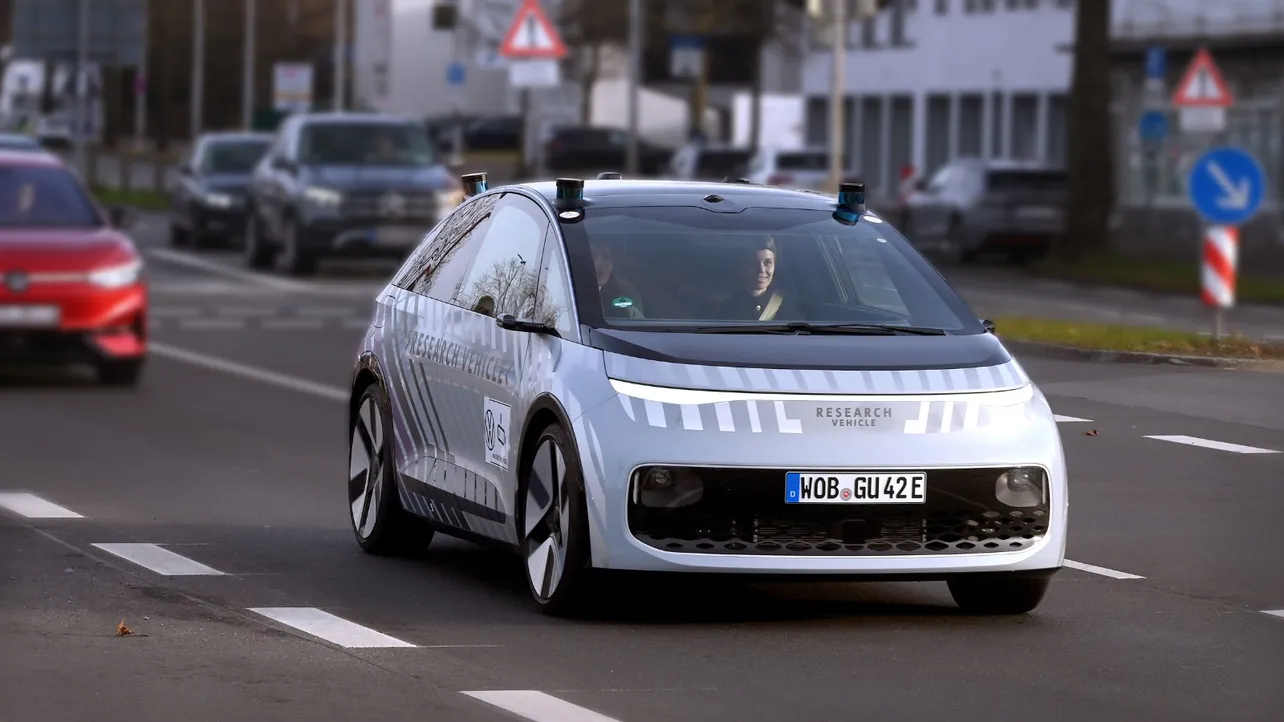
Volkswagen Group has started public-road testing of its Gen.Urban autonomous research vehicle in Wolfsburg, running the steering-wheel-less concept on a fixed urban route around the company’s headquarters, albeit under tightly controlled conditions and with a human safety driver onboard.
The vehicle is not intended for sale and forms part of an internal research programme rather than a commercial deployment. Test participants are Volkswagen Group employees, and each journey lasts around 20 minutes.
Testing moves beyond closed sites
Until now, Gen.Urban had been evaluated primarily in controlled environments. The current phase places it into live city traffic, including junctions, roundabouts, construction zones and congested sections of road, on a predefined loop of just under 10 kilometres through Wolfsburg’s city area.
The route begins at the visitor parking area near Volkswagen’s headquarters and passes industrial, residential and mixed-use sections before returning via Heinrich-Nordhoff-Street. Volkswagen says the route was selected to reflect typical urban traffic scenarios rather than edge-case driving situations.
Focus on passenger experience rather than driving performance
Volkswagen positions the project primarily as a study of passenger behaviour and comfort, rather than a test of autonomous driving capability.
According to the company, the research aims to understand how occupants use their time in a self-driving vehicle, how they interact with digital systems, and whether they feel comfortable travelling without conventional driving controls. The work is being carried out by a cross-disciplinary team covering design, software, human factors and materials development, with findings intended to inform future interior and user-experience concepts across Volkswagen Group brands.
The company does not disclose the vehicle’s autonomy level, sensor configuration or system performance data.
Steering-wheel-less, but supervised
Gen.Urban is designed without a steering wheel or pedals, with the test participant seated in the driver’s position. A trained safety driver sits in the front passenger seat and can intervene at any time using a dedicated control interface with joystick control.
Volkswagen has not indicated whether the system is designed to operate without onboard supervision, and the current test configuration remains dependent on human oversight.
Interior personalisation under evaluation
Much of the development work centres on the vehicle’s interior. Passengers can set preferences for seating position, lighting, temperature and digital display themes either via an app or inside the vehicle, with settings applied automatically on entry.
Volkswagen says artificial intelligence is used to adapt the digital interface and ambient environment to individual users, including the large front display combining visual, light and sound elements. The research also looks at how different passenger groups, including older users and children, respond to these environments and interaction methods.
Early-stage research, limited scope
The Wolfsburg tests are scheduled to run for several weeks and are limited to internal participants. Volkswagen makes no reference to regulatory approvals beyond the test area, provides no timeline for wider trials, and does not link the research to a specific vehicle programme or brand.
As presented, Gen.Urban remains a research platform rather than a step towards customer-facing autonomous services, with the current work focused on understanding interior use and passenger acceptance rather than scaling autonomous operation.