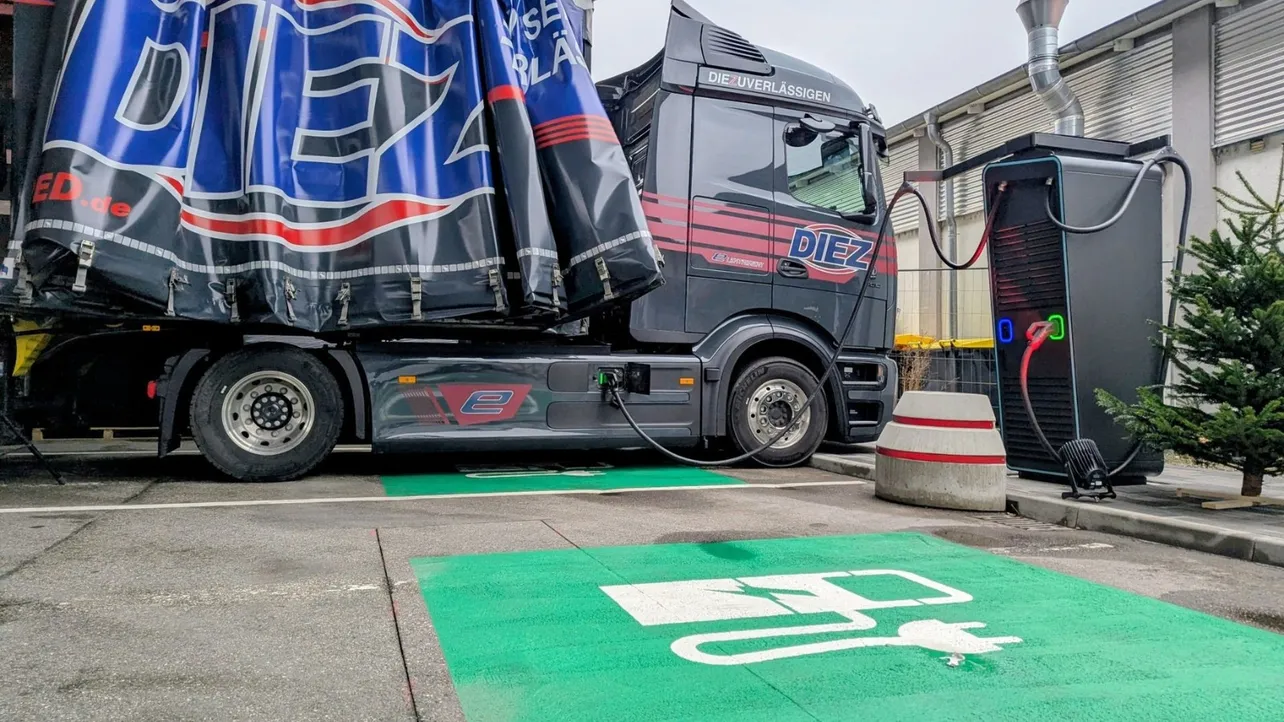
Germany's planned network of 350 electric truck charging parks would need to operate at full capacity for 22 hours a day by 2040 to meet the energy demands of a fully electrified long-haul fleet, according to a new study commissioned by the German Hydrogen Association.
The research by LBST (Ludwig-Bölkow-Systemtechnik) models the infrastructure requirements of decarbonising Germany's approximately 129,000 long-haul trucks under EU CO2 regulations, which mandate a 90% emissions reduction by 2040. It concludes that a 100% battery-electric scenario would place "enormous" strain on the power grid - and positions hydrogen as a necessary complement.
The study was published on 18 December 2025 under the HyMobility project of the DWV (Deutscher Wasserstoff-Verband). Its findings should be read with that context in mind: this is an advocacy document for hydrogen's role in freight decarbonisation, not a neutral infrastructure assessment.
The grid demand problem
LBST models a scenario in which all zero-emission long-haul vehicles recharge during the legally mandated 45-minute midday break after 4.5 hours of driving. Under this assumption, the fleet would require approximately 8GW of charging power during a 4-hour midday window by 2040 - equivalent to roughly 8,000 megawatt-class chargers operating simultaneously.
Germany's federal government has planned 350 truck charging parks with an average grid connection of 8MW each, totalling around 2.8GW of installed capacity by 2030. The study argues this would already face 3.7 hours of full utilisation per day by 2030, rising to 11 hours by 2035 and 22 hours by 2040 - an operationally implausible scenario.
The annual electricity demand for the long-haul fleet alone would exceed 19TWh by 2040, according to LBST's modelling - roughly 26% of Germany's 2024 solar PV output, or 1.5 times Berlin's annual electricity consumption.
Hydrogen as grid relief
The study proposes integrating hydrogen refuelling infrastructure at the same 350 sites, with each location storing approximately 5 tonnes of hydrogen. This would allow around 40,000 hydrogen trucks to refuel daily - roughly 40% of the active fleet - with refuelling times of 10-15 minutes rather than 45-minute charging sessions.
Hydrogen refuelling stations require less than 1MW of grid connection capacity, compared to 8MW or more for megawatt charging sites. The study argues this would reduce peak grid loads, avoid bottlenecks during midday charging windows, and provide operational flexibility that battery-electric trucks cannot match.
LBST acknowledges the efficiency trade-off: hydrogen trucks consume approximately 450kWh per 100km on a well-to-wheel basis, compared to 138kWh for battery-electric. But it frames this as an acceptable cost for "system resilience" - the ability to store renewable electricity as hydrogen and decouple production from consumption.
Context and caveats
The study explicitly states it is "not suitable for planning" and uses simplified assumptions. It does not model depot charging, which other research suggests could handle a significant share of truck energy demand outside peak hours. A 2022 ICCT study, for example, estimated 59% of German truck charging by 2040 would occur overnight at private depots.
The ICCT has also found that battery-electric trucks are projected to have lower total cost of ownership than hydrogen equivalents in Europe through at least 2040, even for long-haul applications. That analysis assumes megawatt charging will be widely deployed by 2030.
Germany's federal government launched its "Power to the Road" initiative in 2024, targeting 350 fast-charging sites covering 95% of federal highways. Whether this network can scale to meet the demands LBST models - or whether hydrogen fills the gap - remains an open question.