Mercedes-AMG's electric flagship has 1,153 hp - and pretends to be a V8
The new GT 4-Door Coupe is AMG's first all-electric model, with up to 1,153 hp, a claimed 435-mile WLTP range and DC charging above 600 kW. To replace the M178 V8, Mercedes has digitised the sound of an older AMG engine and pipes it through the cabin.

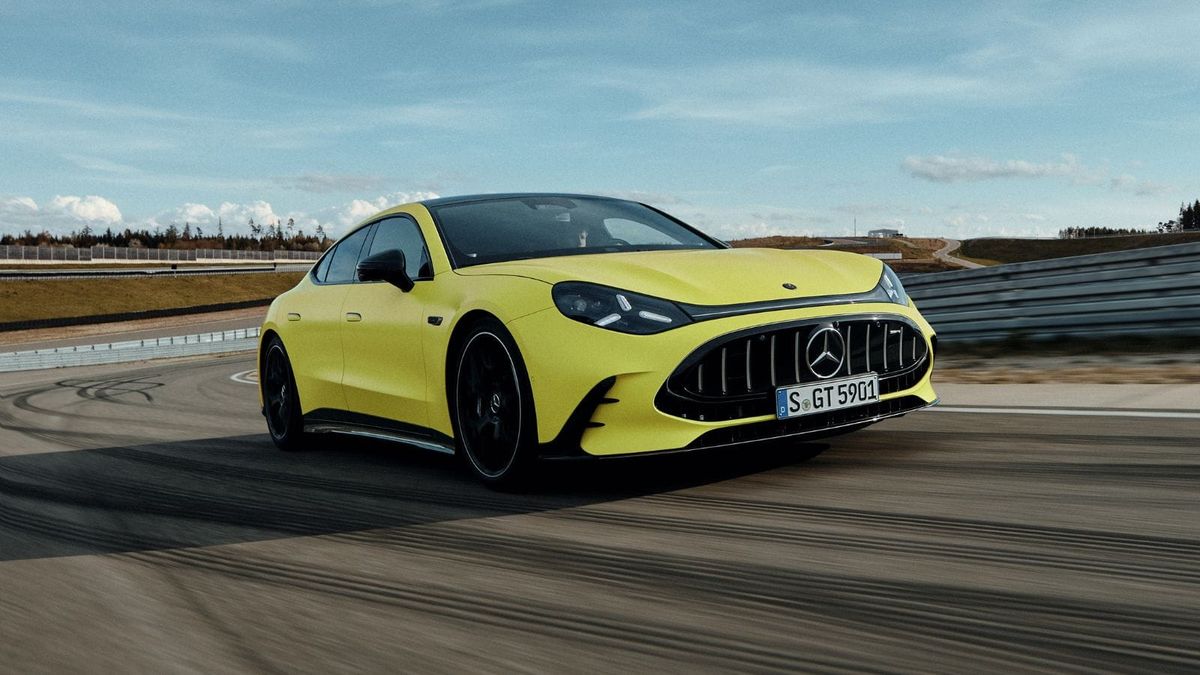
Mercedes-AMG has revealed the second-generation GT 4-Door Coupe with no engine - and fair warning, what follows is an absolute nerdfest. The V8 that defined every previous version of the car is gone, replaced by three electric motors and a 106 kWh battery, with the top-spec GT 63 4Matic+ producing a claimed 1,153 hp. AMG says the car will manage a WLTP-rated 435 miles between charges and can add 286 miles in ten minutes at a 600 kW rapid charger. The catch, depending on your view of these things, is that the V8 hasn't entirely been killed off. It has been digitised.
The car is the first fully electric AMG, and the most aggressive break yet from the M178 4.0-litre twin-turbo V8 that has powered every AMG GT, C 63, E 63 and S 63 worth getting excited about for the best part of a decade. Mercedes-AMG's previous flagship four-door, the GT 63 S 4Matic+, started at £135,550 in the UK and made 630 bhp. This one drops the cylinder count to zero and roughly doubles the power output. It also adds the small matter of a software-controlled artificial soundtrack that, the company says, draws on more than 1,600 audio samples of an actual AMG V8.
Three British motors at the centre of it
The powertrain story is the more interesting one, partly because it is genuinely novel and partly because it happens to be largely British. The motors come from YASA, an Oxford University spin-out founded in 2009 and bought by Mercedes-Benz in 2021. YASA builds axial flux motors - a design in which two flat magnetic discs face each other across a stator, rather than the conventional radial arrangement of magnets surrounding a rotor. The company says the result is a motor that delivers comparable output at around half the weight and size of a typical radial flux unit.
There are three of them in the GT 4-Door. Two sit on the rear axle, each with its own water-cooled inverter and planetary gearset; one on the front axle drives through a spur-gear transmission and a disconnect unit so it can freewheel when the car doesn't need four-wheel drive. The motors are built at YASA's facility in Yarnton, near Oxford, which the company says can now produce more than 25,000 units a year following a £12 million expansion completed in 2025. The control electronics are developed in Welshpool, in Powys.
A flagship Mercedes-AMG, the marque's first fully electric performance car and the spiritual replacement for a long line of Affalterbach V8 brutes, is built around a powertrain designed in Oxford and assembled in Oxfordshire. The car will be sold globally; the motors come from Yarnton.
Acceleration that doesn't really make sense
The GT 4-Door comes in two flavours. The GT 55 makes 805 hp and 1,800 Nm of torque; the GT 63 4Matic+ steps up to 1,153 hp and 2,000 Nm. Mercedes claims a 0-62 mph time of 2.4 seconds for the GT 63 in standard conditions, or 2.1 seconds with one-foot rollout - the US-spec measurement that knocks roughly three-tenths off most launches. Either way, it is faster than most things you can buy and obviously irrelevant for any actual journey you might attempt in the UK.
More usefully, the 800-volt electrical architecture supports DC charging at peak rates above 600 kW. That is roughly double the fastest rate the Porsche Taycan Turbo GT can sustain, and well clear of the 300 kW maximum offered by the Lucid Air Sapphire. If the figures hold up at real-world chargers, a near-full top-up on a stop will plausibly take less time than ordering a sandwich.
The 106 kWh battery uses cylindrical cells immersed in a dielectric coolant, with each cell individually surrounded rather than relying on plates or cooling channels. AMG says this allows the pack to maintain a stable temperature during repeated launches and high-rate charging without thermal throttling. The 435-mile WLTP figure assumes ideal cycle conditions; real-world range will be lower, particularly with any meaningful use of the launch control button.
About that synthesised V8
The headline novelty - and the bit that has caused most automotive journalists to either grin or wince - is the artificial sound. AMG has digitally captured the noise of an existing AMG V8 (the unit from the GT R, according to its engineers), broken it into more than 1,600 individual audio files, and rebuilt the lot inside the car's audio and haptic system. The cabin gets dedicated speakers for the engine note, an external speaker pumps the sound out into the world, and the seats contain shaker units that vibrate in time with the digital combustion. There are simulated nine-speed gear shifts, a fake 7,200 rpm redline, and a digital tachometer that climbs and falls accordingly.
There is a real engineering question buried inside the gimmick, which is whether a performance EV needs aural drama at all - and if it does, whether it should sound like the thing it has just replaced. The Tesla Model S Plaid arguably doesn't need a soundtrack; the silent shove is the point. A 1970s Land Rover Defender doesn't need pipework to feel like itself. AMG appears to have decided that its customers expect a V8 to be present in some form, and the easiest way to deliver that is to record one and play it back. Whether this lands as charming, ridiculous or both will probably depend on how much you already missed the M178.
What it does demonstrate is that Mercedes-AMG has stopped pretending that electric performance can sell itself purely on numbers. The previous EQ-badged efforts - quiet, smooth, jelly-bean shaped - sold poorly. This one wants to feel like an AMG, and AMG has decided that feeling like an AMG means making the right noise.
How it compares to a Taycan Turbo GT
On paper, the AMG slots between the two cars it is most likely to be cross-shopped against. Porsche's Taycan Turbo GT makes 1,019 hp using overboost, claims a 2.1-second 0-60 mph time, and an EPA range of around 275 to 318 miles depending on configuration. The Lucid Air Sapphire is the outlier - 1,234 hp, an EPA range that pushes towards 427 miles, and a sub-two-second 0-60 mph time. AMG's claimed 1,153 hp and 435-mile WLTP figure put the GT 4-Door comfortably ahead of the Taycan and competitive with the Lucid on every metric apart from raw acceleration.
Charging is where AMG's number is most provocative. 600 kW peak is roughly twice what the Porsche manages and double what Lucid offers, though it requires charging infrastructure that does not really exist yet in the UK. Ionity's fastest stalls top out at around 350 kW, and even those are uncommon. The car will charge as quickly as the available charger allows, which for most owners most of the time will not be anything close to 600 kW. But the headroom is there for when the infrastructure catches up.
What it has to do for Mercedes
Mercedes-Benz has had a difficult few years in EVs. The EQS sedan, the company's previous swing at electric flagship motoring, sold 6,963 units in 2024 - a 52% drop on the year before. Design chief Gorden Wagener has admitted publicly that the car was "10 years too early" and that its aerodynamic egg styling did not land with luxury buyers. Mercedes pulled most EQ models from US production late last year, then reintroduced them after dealer pushback. Group EV sales fell by more than half in the first quarter of 2025.
The GT 4-Door arrives with a job to do. It needs to demonstrate that Mercedes-AMG can build a performance EV that customers want enough to buy - not a futuristic blob, but a car that wears the same Affalterbach badge as a £148,950 V8 saloon, drives like it, and roughly sounds like it. The headline numbers suggest it should be quick enough; whether the digital V8 carries the emotional weight will probably take ownership rather than a launch event to determine.
UK pricing hasn't been confirmed. The outgoing GT 63 S 4Matic+ started at £135,550, so expect the new car to land somewhere north of that, with the 1,153 hp GT 63 4Matic+ pushing well beyond £160,000. Mercedes says European deliveries begin in late 2026.