Coca-Cola adds eActros 600 alongside hydrogen truck in German fleet
German beverage giant now testing both battery-electric and hydrogen heavy trucks from the same zero-emission rental provider.

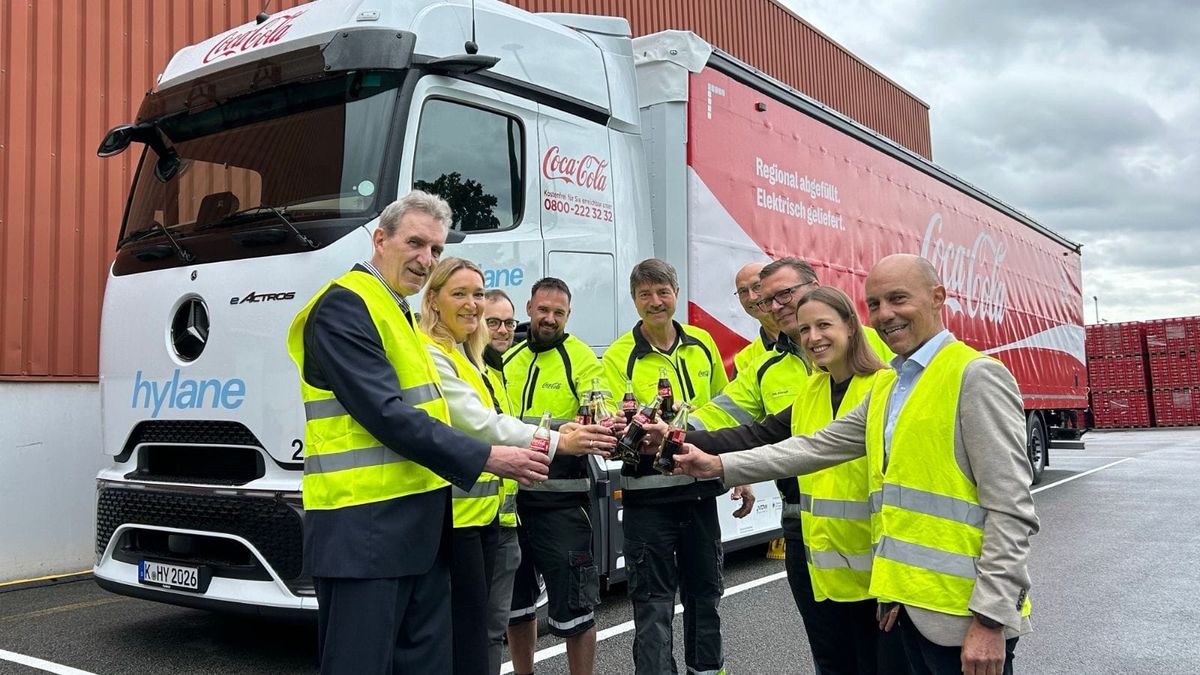
Coca-Cola Europacific Partners Germany has deployed a battery-electric Mercedes-Benz eActros 600 from hylane, the Cologne-based zero-emission truck rental company, for beverage transport in the Mannheim area. The drinks bottler already operates one of hylane's Hyundai XCIENT Fuel Cell hydrogen trucks, giving it a direct comparison between the two drivetrains in its heavy-duty logistics fleet.
The eActros 600 LS 4x2 tractor unit has a range of approximately 310 miles (500 km) from its 620 kWh battery pack, peak output of 600 kW, and can charge at up to 400 kW via the Combined Charging System (CCS) or 1,000 kW via the Megawatt Charging System (MCS). Permissible gross vehicle weight in combined transport is up to 44 tonnes.
Solving the payload problem
Beverage logistics is among the most weight-sensitive applications in road freight. Every kilogram of battery adds a kilogram less of product on the trailer, and the 11.5-tonne-per-axle limit in Germany leaves little margin. Coca-Cola and hylane have addressed this by pairing the eActros 600 with a BERGERecotrail semi-trailer from Schmitz Cargobull, the German trailer manufacturer, which has a tare weight below 4,700 kg - significantly lighter than a standard curtainsider. The combination uses an optimised wheelbase to maximise both cargo space and axle load utilisation.
The trailer is also fitted with Schmitz Cargobull's SpeedCurtain tarpaulin system for faster loading and unloading - a practical consideration for multi-drop beverage rounds.
From hydrogen-only to technology-agnostic
hylane launched in 2021 as Germany's first zero-emission truck rental service, putting its first Hyundai XCIENT Fuel Cell on the road in November 2022. The company has since grown its hydrogen fleet to more than 100 vehicles, but has added battery-electric trucks over the past year. Its largest battery-electric contract to date is a deal with DHL for 42 eActros 600 trucks, the first eight of which entered service in December 2025.
Both the tractor unit and trailer are provided under hylane's pay-per-kilometre rental model, which removes the upfront capital outlay that still deters many fleet operators from zero-emission trucks.
"We share with Coca-Cola a technological openness to emission-free transport in heavy-duty road freight," said Dr Sara Schiffer, founder and CEO of hylane. "Testing and evaluating different drive concepts early on is the only way to determine which technology mix will allow for the economically and sustainably scalable decarbonisation of heavy-duty transport."
Coca-Cola's wider electrification push
CCEP Germany completed the electrification of its entire 1,600-vehicle passenger car and light commercial vehicle fleet by the end of 2025, ahead of its original 2030 target, with 170 charging stations installed across 23 sites. Heavy-duty trucks represent the next stage of that transition, though the company has framed both hylane deployments as long-term tests rather than a commitment to fleet-wide rollout.
"Together with our drivers, we want to gather targeted experience with modern, emission-free technologies over several years," said Dirk Stenzel, national fleet manager at CCEP Germany. "Only through comprehensive long-term tests can we find ways to meet the complex requirements with modern technology."
The eActros 600 is the most widely deployed long-haul electric truck in Europe, with Mercedes-Benz selling 530 zero-emission heavy units in the first quarter of 2026 - a 5.6-fold increase on the same period last year. Rivals are closing the gap on range, with Volvo's FH Aero Electric now claiming up to 435 miles (700 km) and Renault Trucks pushing its E-Tech T to 410 miles (660 km).